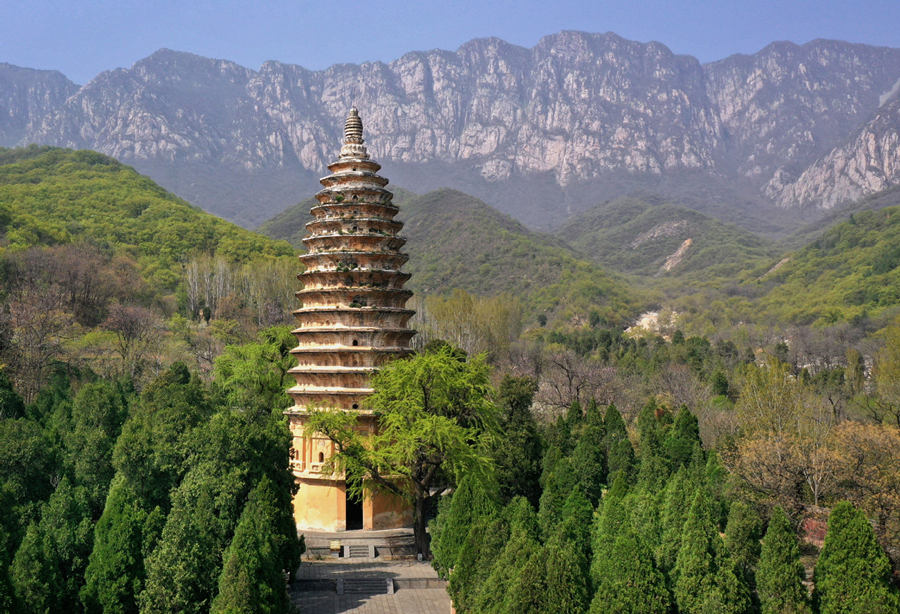
Songyue Temple Pagoda
Introduction
The Songyue Temple Pagoda, often referred to simply as the Songyue Pagoda, is a notable architectural and cultural landmark located at the southern foot of Songshan Mountain in Dengfeng city, Henan province. It forms part of the historic monuments of Dengfeng, known as "The Centre of Heaven and Earth", and is a testament to the rich religious and cultural history that has shaped the region over centuries.
The Songyue Pagoda is particularly renowned for its unique architectural style and historical importance, standing as one of the oldest extant pagodas in China. Its significance is further highlighted by its inclusion in the UNESCO World Heritage List as part of the "Historic Monuments of Dengfeng in The Centre of Heaven and Earth".
History
The history of the Songyue Temple Pagoda is deeply intertwined with the development of Buddhism in China. Constructed during the Northern Wei Dynasty (386-534), the pagoda is one of the earliest brick pagodas in existence. The Northern Wei Dynasty was a period marked by the assimilation of Buddhist teachings into Chinese culture, leading to the construction of numerous temples and pagodas across the region.
The Songyue Pagoda is a reflection of this historical period, showcasing the architectural innovations that were adopted as Buddhism began to spread throughout China. Over the centuries, the pagoda has seen numerous restorations, each contributing to its preservation and enduring legacy. Despite these changes, it retains much of its original structure, allowing modern visitors to glimpse into the architectural and religious aspirations of ancient Chinese society.
Architecture
Design and Structure
The Songyue Temple Pagoda is celebrated for its distinctive architectural design, which stands out as an early example of the transition from wooden to brick construction in Chinese pagodas. Its circular shape is particularly unusual for the era, as most pagodas were traditionally square in design. The structure consists of twelve sides, giving it a dodecagonal appearance that is both unique and aesthetically pleasing.
The pagoda rises to a height of approximately 40 meters, with each of its levels slightly smaller than the one below, creating a tapering effect that enhances its verticality. The design incorporates both Indian and Chinese architectural influences, reflecting the cultural exchanges that occurred along the Silk Road. The pagoda's intricate carvings and decorative elements further exemplify the skilled craftsmanship of the period.
Materials Used
Constructed primarily of brick, the Songyue Temple Pagoda marks a significant departure from the wooden structures that were more common in earlier Chinese architecture. The use of brick not only provided greater durability but also allowed for more intricate detailing in the pagoda's design. The bricks used in its construction were carefully crafted and arranged to create the pagoda's distinctive shape and decorative elements.
In addition to brick, some stone elements are incorporated into the structure, particularly in the foundation and base, to increase stability. This combination of materials contributed to the pagoda's resilience, enabling it to withstand the test of time and remain one of the best-preserved structures of its kind from the Northern Wei period.
Cultural Significance
The Songyue Temple Pagoda is not only an architectural marvel but also a cultural symbol of the fusion between Chinese and Buddhist traditions. The pagoda and its surrounding temples have served as places of worship and pilgrimage for centuries, attracting visitors seeking spiritual enlightenment and cultural enrichment. The pagoda's design and construction exemplify the profound impact of Buddhism on Chinese culture, highlighting the religion's role in shaping the country's architectural and artistic heritage.
Conservation Efforts
Efforts to conserve the Songyue Temple Pagoda have been ongoing, ensuring that this historical gem is preserved for future generations. These efforts include structural assessments, restoration of damaged sections, and protective measures against environmental and human-induced threats. The pagoda's inclusion in the UNESCO World Heritage List has also bolstered conservation initiatives, drawing attention and resources to its preservation. Local and national authorities work together to maintain the integrity of the site, implementing guidelines and strategies that align with international conservation standards.








